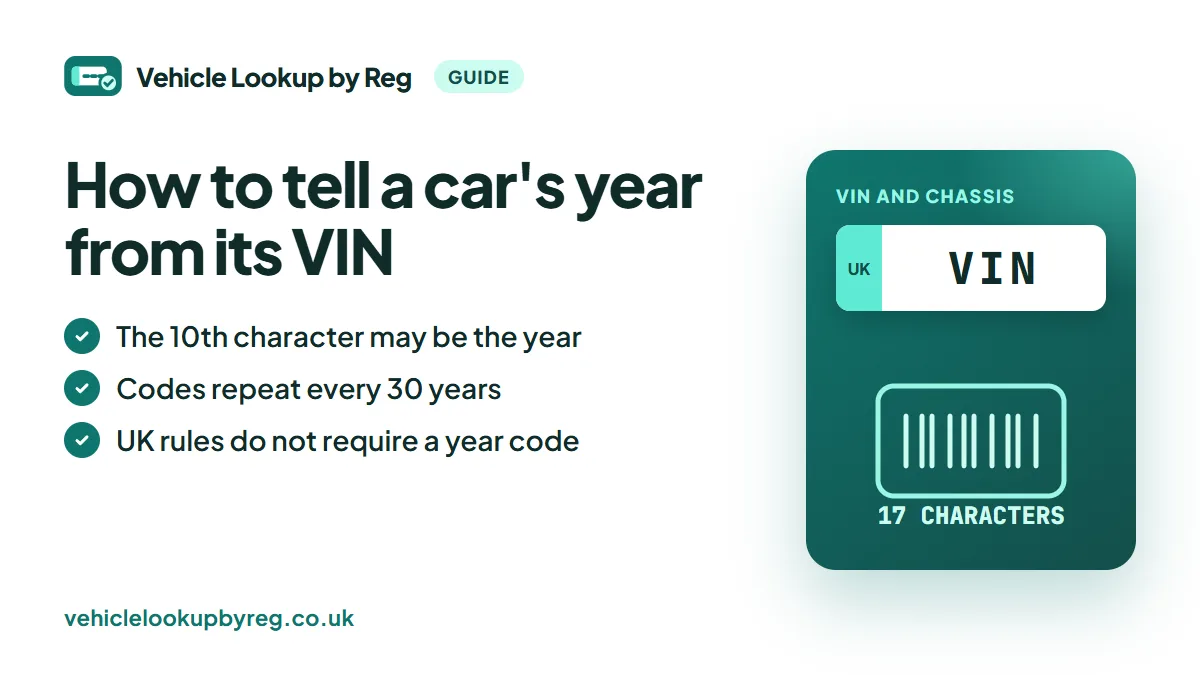
On many cars the 10th character of the VIN is a model year code: A to Y stand for 2010 to 2030, skipping I, O, Q, U and Z, then 1 to 9 for 2031 to 2039, and the codes repeat every 30 years. The code is compulsory on cars built to US rules but not under the rules for UK cars, so always check the year against the registration record too.
This guide gives the full year table, shows how to tell which 30-year cycle applies, explains why the model year is not always the year the car was built, and shows how to find a UK car's real dates from its registration in seconds.
In this guide
- Which character of the VIN shows the year?
- What does each VIN year code mean?
- How do you know which 30-year cycle applies?
- Is the model year the year the car was made?
- How do you find a UK car's year without decoding the VIN?
- What else can you read from a VIN besides the year?
- Why might the VIN year and the registration year differ?
- How do you get the year of vehicle from VIN if that is all you have?
- Questions and answers
- Sources
Which character of the VIN shows the year?
A VIN has 17 characters. Counting from the left, the 10th is the first character of the last section, the part that identifies the individual car. The US federal rules on VIN content (49 CFR 565.15) say this character must represent the vehicle's model year. Cars built to those rules carry a year code there; on other cars the maker may use the position for something else.
The type-approval rules used in Great Britain (Regulation (EU) No 19/2011) describe the same three sections and ban the letters I, O and Q, but they do not ask for a year code anywhere in the VIN. That is why a VIN decoder by year is a strong clue on some cars and no help at all on others.
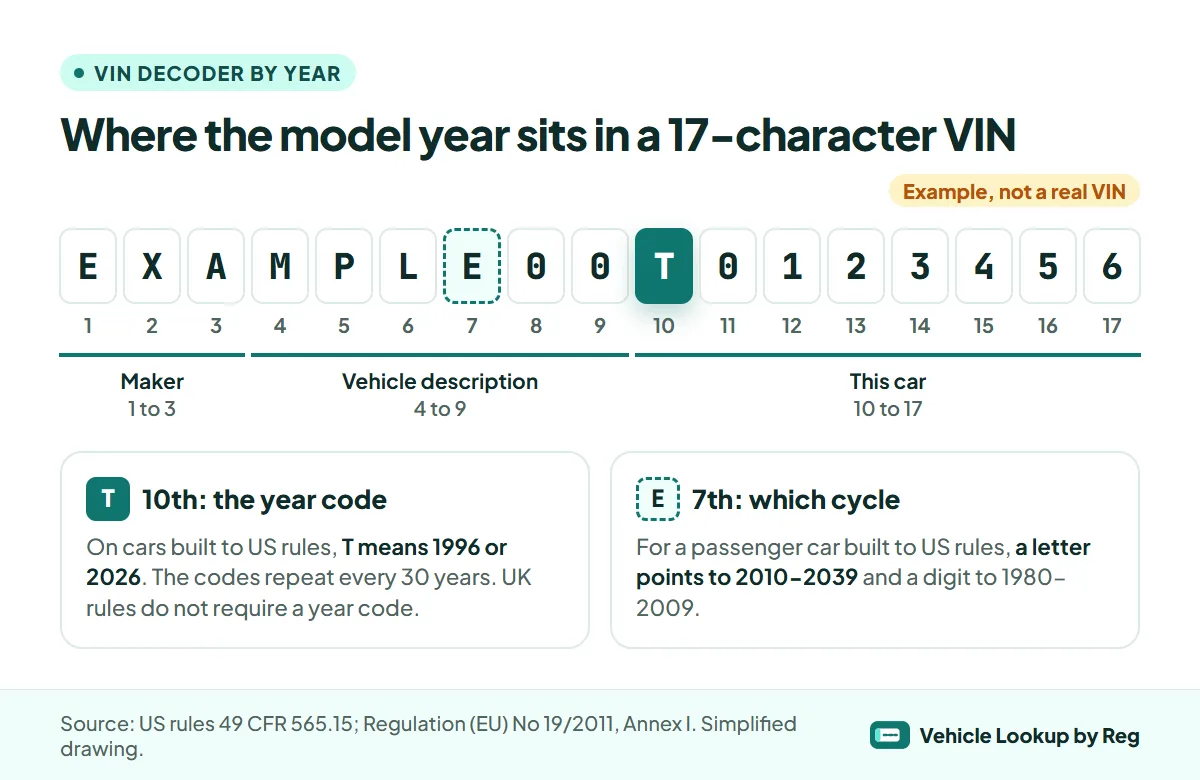
What does each VIN year code mean?
This is the model year table from the US rules. Each code stands for one year in each 30-year cycle, so every code has two possible years.
| Code | Model year, 1980-2009 cycle | Model year, 2010-2039 cycle |
|---|---|---|
| A | 1980 | 2010 |
| B | 1981 | 2011 |
| C | 1982 | 2012 |
| D | 1983 | 2013 |
| E | 1984 | 2014 |
| F | 1985 | 2015 |
| G | 1986 | 2016 |
| H | 1987 | 2017 |
| J | 1988 | 2018 |
| K | 1989 | 2019 |
| L | 1990 | 2020 |
| M | 1991 | 2021 |
| N | 1992 | 2022 |
| P | 1993 | 2023 |
| R | 1994 | 2024 |
| S | 1995 | 2025 |
| T | 1996 | 2026 |
| V | 1997 | 2027 |
| W | 1998 | 2028 |
| X | 1999 | 2029 |
| Y | 2000 | 2030 |
| 1 | 2001 | 2031 |
| 2 | 2002 | 2032 |
| 3 | 2003 | 2033 |
| 4 | 2004 | 2034 |
| 5 | 2005 | 2035 |
| 6 | 2006 | 2036 |
| 7 | 2007 | 2037 |
| 8 | 2008 | 2038 |
| 9 | 2009 | 2039 |
The letters I, O, Q, U and Z and the digit 0 are never year codes. If you find one of them in 10th place, the maker is not using that position for the year, and the table cannot help with that car.
How do you know which 30-year cycle applies?
Every code repeats: T is 1996 or 2026, and A is 1980 or 2010. For passenger cars, the US rules settle it with the 7th character. If the 7th character is a digit, the year code points to 1980-2009; if it is a letter, to 2010-2039.
For any car with a UK registration, the record settles it faster. A car whose year of manufacture is 2016 is not a 1986 model, whatever its VIN seems to say.
Is the model year the year the car was made?
Not necessarily. The US rules define the model year as the year a manufacturer uses to name a model, regardless of the calendar year in which the car was actually built, provided that model year's production lasts no more than 24 months. A car built in the autumn of one year can carry the code for the next.
In the UK, the dates on the registration record matter more. The DVLA records the year of manufacture and the date of first registration, the V5C must show the date of first registration in the UK (and abroad, for an imported car), and a car's first MOT in Great Britain is due by the third anniversary of its registration. The car reg date check explains what each date means.
How do you find a UK car's year without decoding the VIN?
- Type the registration into the free check box on this page.
- Read the year of manufacture and the month of first registration on the car's page. Both come from the DVLA.
- Compare them with the advert, the V5C and, if it is a year code, the 10th character of the VIN.
The free page also shows the make, model, engine size and every MOT test with its mileage, so you see the car's age and its life on the road together. For everything held on the car, including keepers and the finance, write-off and stolen checks, run a vehicle lookup by reg.
What else can you read from a VIN besides the year?
Not much on its own, and less than many decoders suggest. These are the parts with a fixed meaning:
- Characters 1 to 3 are the world manufacturer identifier, assigned by an authority in the maker's home country. Under the GB type-approval rules, a maker building fewer than 500 vehicles a year always has a 9 as the third character.
- Characters 4 to 9 describe the vehicle's general characteristics, in a way each maker chooses.
- Characters 10 to 17 identify the individual vehicle, and the last four are always digits.
- On cars built to the US rules, the 9th character is a check digit (0 to 9, or X) that shows whether a VIN has been copied correctly, and the 11th shows the plant where the car was built.
None of this replaces a look at the records. The VIN tells you who made a car and, sometimes, its model year; the registration record tells you when it was made and first registered, and what has happened to it since.
Why might the VIN year and the registration year differ?
- The model year ran ahead of the calendar. A car built late in one year may carry the next year's code.
- The car was registered long after it was built. The year of manufacture and the date of first registration can be far apart, for example for a car registered in the UK after years abroad.
- The 10th character is not a year code. On a car not built to the US rules, the maker may use that position for something else.
- The VIN or the plates do not belong to the car. A gap of many years that none of the reasons above explains is a warning sign: compare the VIN on the car, on the V5C and on record before going any further.
Watch outNever judge a car's age from the VIN alone: check the year of manufacture and the date of first registration on its record as well.
How do you get the year of vehicle from VIN if that is all you have?
Read the 10th character and find it in the table above. If the car was built to the US rules, the 7th character tells you the cycle. Treat the answer as a model year, not a build date, and remember that some VINs have no year code at all.
If you have the registration too, the record is quicker and more reliable. If you have neither number to hand, the V5C logbook holds both, with the date of first registration. Our guide on finding a chassis number online shows where else the VIN appears.
Questions and answers
What does the 10th character of a VIN mean?
On cars built to the US rules it is the model year code: letters from A for 2010 to Y for 2030, then the digits 1 to 9 for 2031 to 2039. On other cars the maker may use it differently.
Does every UK car have a year code in its VIN?
No. The rules for cars approved in Great Britain describe the three sections of the VIN but do not require a year code, so check the year against the registration record.
What year is a VIN with T in 10th place?
T stands for 1996 or 2026. For a passenger car built to the US rules, a letter in 7th place points to 2026 and a digit to 1996.
Why is there no letter O in a VIN?
The VIN rules do not allow the letters I, O and Q anywhere in the number, so a round character in a VIN is always the digit zero.
Is the model year the same as the year of manufacture?
Not always. The model year names the model and can differ from the calendar year the car was built. The year of manufacture on the UK record is the better guide to a car's age.
Sources
Every fact in this guide was checked on 9 November 2026 against these pages:
- Cornell LII: US rules on VIN content, 49 CFR 565.15 (model year codes)
- Cornell LII: US VIN definitions, 49 CFR 565.12 (model year)
- legislation.gov.uk: Regulation (EU) No 19/2011, Annex I (VIN structure)
- GOV.UK: Get vehicle information from DVLA
- GOV.UK: Getting an MOT (first MOT by the third anniversary of registration)
- legislation.gov.uk: Road Vehicles (Registration and Licensing) Regulations 2002, regulation 10A
This guide is general information about UK vehicles, not legal advice. Vehicle Lookup by Reg is an independent service and is not affiliated with the DVLA, the DVSA or GOV.UK.