You can find your chassis number online without walking out to the car. Download a copy of one of its MOT certificates from GOV.UK, where the VIN is the first item, ask the DVLA for its record with a free subject access request, or get a report by registration that shows the full VIN. The free DVLA and MOT lookups do not show it on screen.
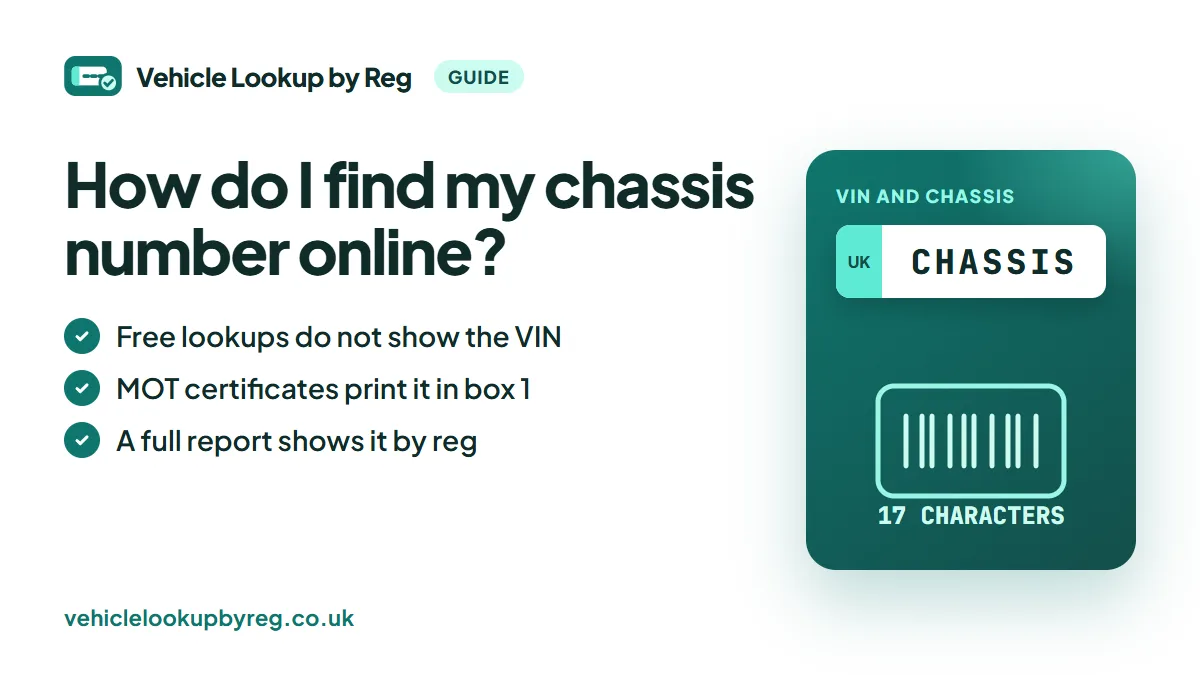
On a modern car the chassis number and the VIN are the same 17 characters. This guide explains each online route, what you need for it, which one works for a car you do not own yet, and what to do if the number you find does not match the car.
In this guide
- What exactly is a chassis number?
- Can you find a chassis number online for free?
- How do you get your chassis number from an MOT certificate?
- How to get chassis number online from the DVLA
- Where is the chassis number if you have the logbook or the car?
- How to find vehicle chassis number online for a car you are buying
- What if the chassis number does not match the car?
- Questions and answers
- Sources
What exactly is a chassis number?
It is the vehicle identification number, or VIN: the code the manufacturer marks on a vehicle when it leaves the production line. The type-approval rules used in Great Britain say the VIN stamped on the chassis must be at least 7 mm high, and that is where the older name comes from.
A VIN has 17 capital letters and digits in three parts: three characters for the manufacturer, six that describe the vehicle and eight that identify the car itself, the last four always digits. The letters I, O and Q are never used, so a round character is always a zero. Each VIN belongs to one vehicle only.
You will meet both names. The law on what a V5C must contain lists "the vehicle identification number" and "the chassis or frame number" side by side, and GOV.UK uses both when it explains which changes to a car need a DVLA inspection.
Can you find a chassis number online for free?
Not by typing a registration into the free government lookups. Both are useful, but neither puts the VIN on the results page:
| Route | What you need | Shows the chassis number? |
|---|---|---|
| DVLA vehicle enquiry (GOV.UK) | The registration | No. It shows tax, MOT expiry, first registration, year of manufacture, engine size, fuel, CO2 and the last V5C issue date |
| MOT history (GOV.UK) | The registration | Not on the results page, but a certificate you download prints it (tests in England, Scotland and Wales) |
| DVLA subject access request | A form, sent by email or post | It covers the information the DVLA holds about your own vehicle |
| Premium report | The registration | Yes, the full VIN on record |
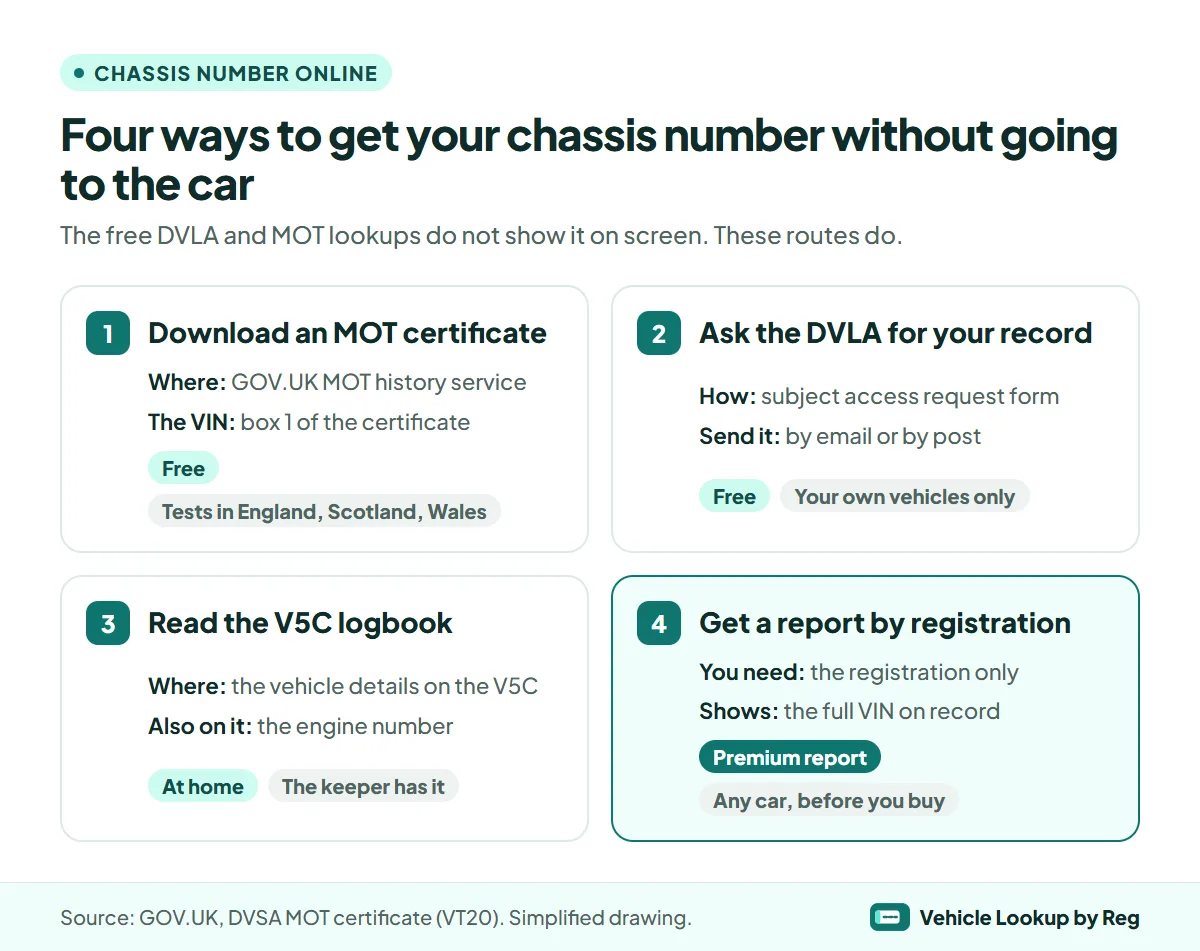
So the free routes that work are the ones that hand you a document about your own car: an MOT certificate or your DVLA record. The diagram sums up the four ways, with what each one asks of you.
How do you get your chassis number from an MOT certificate?
The MOT certificate is the quickest free route. On the current design, box 1 at the top is headed "Vehicle identification number", with the full 17 characters printed under it, above the registration.
- Open the "Check the MOT history of a vehicle" service on GOV.UK.
- Type the registration and open the car's list of MOT tests.
- Download the certificate of a test done in England, Scotland or Wales. Keep the 11-digit reference from the V5C nearby: GOV.UK asks for it to show some of the test details.
- Copy the 17 characters from box 1 carefully, or keep the PDF somewhere safe.
The DVSA's guidance for MOT centres confirms that owners can get a duplicate certificate free of charge online, so there is no need to go back to the garage that did the test.
There are two limits. A car in Great Britain needs its first MOT by the third anniversary of its registration, so a newer car has no certificate yet. And the service cannot download certificates for tests done in Northern Ireland: GOV.UK points to nidirect for a duplicate while the MOT is still valid.
How to get chassis number online from the DVLA
You can ask the DVLA for the information it holds about you and about your current vehicle, or about one that used to be registered in your name. This is called a subject access request, and GOV.UK says it is free.
- Download the subject access request form from the GOV.UK page "Request information about you or your vehicle", and fill it in on screen or on paper.
- Keep your driving licence and the V5C to hand: GOV.UK says you may need them to fill in the form.
- Send the form to the DVLA's subject access team by email, or by post to the Swansea address given on the same page.
GOV.UK does not say how long an answer takes, so this route suits a keeper who has lost the logbook and has no MOT certificate to download, rather than someone who needs the number today.
It only covers you and your own vehicles. Information about another person's vehicle or its keeper is asked for in a different way, and the DVLA gives keeper details only to people with a reasonable cause.
Where is the chassis number if you have the logbook or the car?
If the V5C logbook is at home, the VIN is printed among the vehicle details. The rules on what the registration document must contain list it with the engine number, unless the DVLA does not have it.
On the car, the VIN is stamped into the chassis, and it also appears on the manufacturer's statutory plate, a riveted metal plate or a tamper-evident label that must show it in characters at least 4 mm high. Where both are depends on the make and model. Our guide on the engine code and engine number covers the other number buyers are told to compare.
How to find vehicle chassis number online for a car you are buying
The MOT certificate and the DVLA request are routes for the keeper. When the car still belongs to someone else, there are two ways to get the VIN before you travel:
- Ask the seller. A genuine seller can read it to you from the V5C. You still have to compare it with the car itself at the viewing.
- Get it on record yourself. The Premium report (£7.99) shows the full VIN held on record for the registration, with the outstanding finance, write-off and stolen checks, so it does not depend on what the seller says. The car lookup by registration page lists everything the report covers.
With the number in hand, the check at the viewing takes a couple of minutes. To see the car's details and MOT history first, start with a free car check by registration.
What if the chassis number does not match the car?
GOV.UK tells buyers to check that the vehicle identification number and the engine number on the car match the logbook. Read every character, including the last eight: those identify the individual car, while the start of the number can be the same on other cars of the same type.
Watch outIf the VIN on the car, the VIN on the V5C and the VIN on record do not all agree, do not buy the car: the plates or the paperwork may belong to another vehicle.
On a car you already own, a mismatch is most often a copying mistake, so check the number again in good light. If the logbook itself is wrong, GOV.UK explains how to correct vehicle details on a V5C, and a change to a VIN or chassis number may need a DVLA inspection.
Questions and answers
Can I find my chassis number with just my registration?
Not on the free DVLA and MOT lookups, which do not show it on screen. A copy of an MOT certificate downloaded from GOV.UK prints it, and so does a paid report by registration that includes the full VIN.
Is the chassis number on the MOT certificate?
Yes. The first box of the MOT certificate is the vehicle identification number, which is the chassis number on a modern car.
Is a DVLA subject access request free?
Yes. GOV.UK says asking the DVLA for the information it holds about you or your vehicle is free. You send the form by email or post.
How many characters is a chassis number?
A modern VIN has 17 characters: capital letters and digits, never the letters I, O or Q. The last four characters are always digits.
Can I get the chassis number of someone else's car?
Not from the free lookups, and the DVLA's free request only covers you and your own vehicles. Ask the seller, or get the full VIN on record from a paid report by registration.
Sources
Every fact in this guide was checked on 9 November 2026 against these pages:
- GOV.UK: Check the MOT history of a vehicle (download MOT certificates)
- DVSA: example MOT test certificate VT20 (box 1, vehicle identification number)
- GOV.UK: MOT testing guide, documentation (duplicate certificates)
- GOV.UK: Request information about you or your vehicle from DVLA
- legislation.gov.uk: Regulation (EU) No 19/2011, Annex I (the VIN and the statutory plate)
- GOV.UK: Check a used vehicle you're buying
This guide is general information about UK vehicles, not legal advice. Vehicle Lookup by Reg is an independent service and is not affiliated with the DVLA, the DVSA or GOV.UK.