You cannot check an engine code from a reg on the free government records: the DVLA and MOT records give the engine size in cc and the fuel type, not the manufacturer's engine code. The code is marked on the engine itself. The engine number, which is a different thing, is printed on the V5C logbook.
This guide explains the difference between the engine code and the engine number, where to find each one, what the free records can still confirm from a registration, and when the VIN helps.
In this guide
- What is the difference between an engine code and an engine number?
- Can you check an engine code from the reg for free?
- Where do you find the engine code on the car?
- How do you find the engine number?
- What if the car has had a replacement engine?
- Can you find engine code from VIN in the UK?
- What does the engine size in the records tell you?
- Questions and answers
- Sources
What is the difference between an engine code and an engine number?
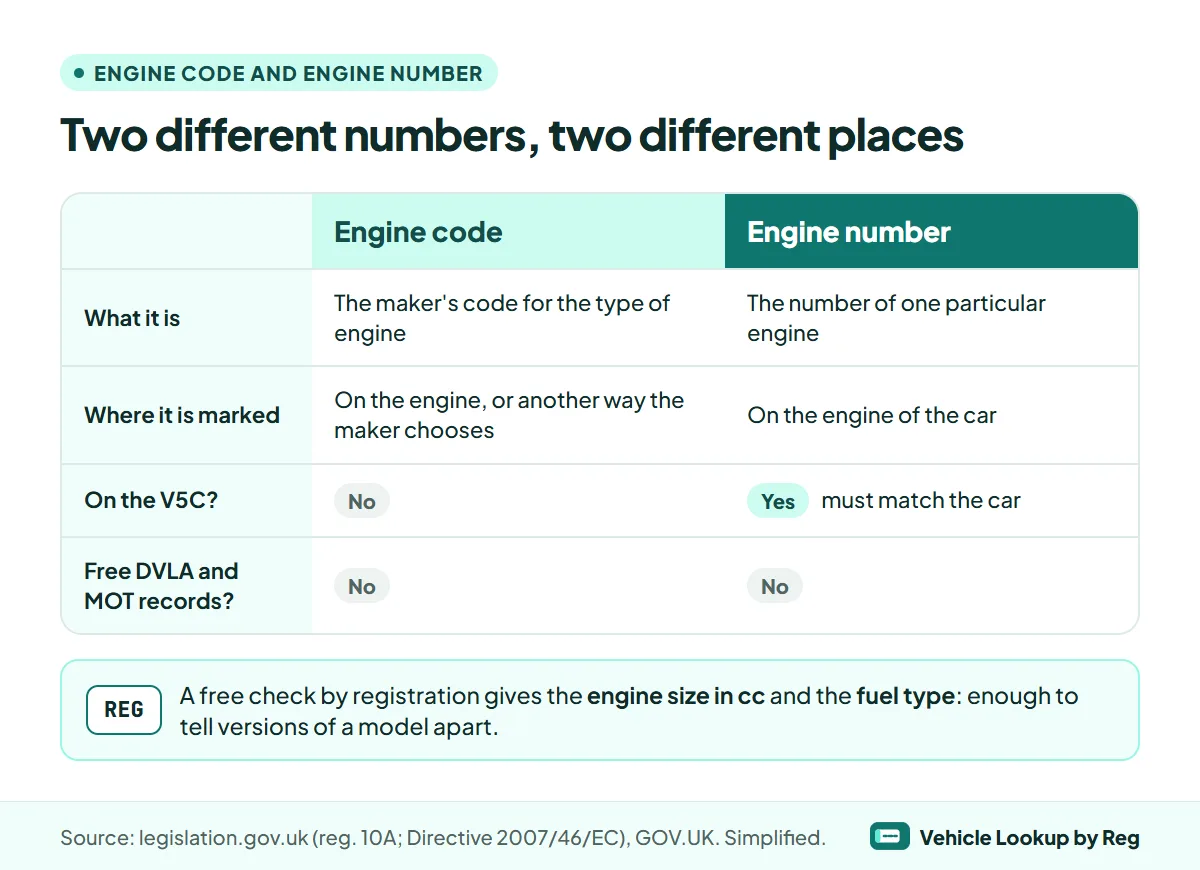
They answer two different questions. The engine code says which engine design the car has; the engine number says which individual engine it is.
| Question | Engine code | Engine number |
|---|---|---|
| What is it? | The manufacturer's code for the type of engine | The number that identifies one particular engine |
| Where is it? | Marked on the engine, or identified in another way the maker chooses | On the engine of the car, and on the V5C |
| Must the V5C show it? | No, it is not in the list of what a V5C contains | Yes, unless the DVLA does not have it |
| Is it in the free DVLA or MOT records? | No | No |
| What is it good for? | Telling apart engines of the same size, for example when buying parts | Proving the engine is the one recorded for the car |
Type-approval paperwork for a new car type has asked makers for the "manufacturer's engine code (as marked on the engine or other means of identification)". The law on what a registration document must contain lists the engine number instead, next to the VIN and the engine cylinder capacity.
Can you check an engine code from the reg for free?
Not directly. The two free government lookups by registration show what the DVLA and the DVSA hold on the car:
- The DVLA's vehicle enquiry service gives the engine size in cubic centimetres, the fuel type, CO2 emissions and the year of manufacture.
- The MOT history adds the model, with every test and the mileage recorded at each one.
Neither has a field for the engine code or the engine number. What they do give you is a quick way to narrow the choice: where a model was sold with engines of different sizes, or in petrol and diesel versions, the cc and the fuel type settle which one the car has. Our free car details from a reg number page shows both from the registration.
Where do you find the engine code on the car?
The maker marks the code on the engine, or identifies it in some other way it chooses, so where you find it differs from one make and engine to the next. The car's handbook or the maker's service information may show where it is on your engine.
When you find it, clean the area gently and take a photo so you can zoom in. Write the code down exactly as marked: letters and digits that look alike are easy to mix up, and a code read wrongly leads to the wrong part.
How do you find the engine number?
The quickest place is the V5C logbook. The law on what a registration document must contain lists the engine number, with the VIN and the engine cylinder capacity, "unless it is not available" to the DVLA, so a blank is possible but worth a question.
On the car, the engine number is on the engine itself, and that is the copy that counts when you buy. GOV.UK's advice to buyers is to check that the vehicle identification number and the engine number on the car match the logbook.
Watch outIf the engine number on the car does not match the V5C, ask why before you buy: a change of engine must be reported to the DVLA so that the logbook is updated.
What if the car has had a replacement engine?
A new or second-hand engine is legal, but the change has to be recorded. GOV.UK lists a change of engine, and a change of cylinder capacity, among the changes a keeper must report on the V5C, and the DVLA rejects the update without one of these pieces of evidence:
- a receipt for the replacement engine that gives its engine number and cylinder capacity
- written evidence from the manufacturer
- an inspection report provided for insurance purposes
- written confirmation from a garage on headed paper, if the change took place before the keeper bought the car
If a seller tells you the engine has been replaced, ask to see that evidence and check that the V5C shows the number of the engine now fitted. If the new engine is a different size, the cylinder capacity on the logbook should have been changed as well, and the receipt should give the same figure.
Can you find engine code from VIN in the UK?
Sometimes, but not by reading the VIN yourself. The US rules say characters 4 to 8 of a passenger car's VIN must describe things such as its engine type. The rules used for cars approved in Great Britain only say that six characters, the 4th to the 9th, indicate the vehicle's general characteristics, without saying which ones or how, so there is no standard engine code inside a UK car's VIN.
What the VIN does is identify the car exactly. The same rules require the manufacturer to be able to trace each vehicle by its VIN for 30 years, which makes a dealer for the make the natural place to ask which engine the car was built with. To get the VIN, see our guide on finding a chassis number online.
What does the engine size in the records tell you?
The DVLA records the engine capacity in cubic centimetres, not litres. Divide the figure by 1,000 and round it to one decimal place to read it the way adverts and badges usually do.
Compare that figure and the fuel type with the advert, the V5C and the car. A difference will not give you the engine code, but it does tell you that the car or the paperwork is not what was described, which matters more than any part number.
If you are buying, a vehicle lookup by reg puts the free details and the MOT history in one place, and a paid report adds the keepers, plate changes and the finance, write-off and stolen checks. Our guide on the V5C issue date explains what to compare on the logbook.
Questions and answers
Is the engine code on the V5C?
No. The V5C must show the engine number and the engine cylinder capacity, but the manufacturer's engine code is not in the list of what it has to contain.
Is the engine number the same as the engine code?
No. The engine code names the type of engine, so many engines share it. The engine number identifies one individual engine, and it is the one recorded on the V5C.
Can I find my engine code by registration number?
Not on the free DVLA or MOT records, which show the engine size and the fuel type only. They help narrow it down; the code itself is marked on the engine, and the manufacturer can trace the car by its VIN.
Where is the engine number on a car?
It is on the engine itself, in a place that depends on the make and the engine. GOV.UK advises buyers to check that it matches the number printed on the V5C.
Do I have to tell the DVLA if I change the engine?
Yes. GOV.UK lists a change of engine, and a change of cylinder capacity, among the changes you must report on the V5C.
Sources
Every fact in this guide was checked on 9 November 2026 against these pages:
- legislation.gov.uk: Road Vehicles (Registration and Licensing) Regulations 2002, regulation 10A (what the V5C must show)
- legislation.gov.uk: Directive 2007/46/EC, Annex I part 3 (manufacturer's engine code)
- GOV.UK: Get vehicle information from DVLA
- GOV.UK: Change vehicle details on a V5C (what to report and what evidence to give)
- GOV.UK: Check a used vehicle you're buying
- legislation.gov.uk: Regulation (EU) No 19/2011, Annex I (VIN sections and traceability)
This guide is general information about UK vehicles, not legal advice. Vehicle Lookup by Reg is an independent service and is not affiliated with the DVLA, the DVSA or GOV.UK.